The #1 Mistake Buyers Make When Moving to Blacksburg, VA
You can spend months researching Blacksburg, find a home that looks perfect online, and still make costly mistakes after you arrive. Grant walks through the biggest relocation mistakes he sees, starting with how buyers choose an agent, and including terrain, lenders, budgets, and location.
Grant Irby
REALTOR®, University & Main Real Estate Group · Keller Williams New River Valley
You can spend months researching Blacksburg, find the perfect home, and still make mistakes that cost you thousands of dollars after you move here. A lot of buyers relocating to Blacksburg are making the same mistakes because they're relying on what they can see online. There are a few things about this market you simply can't understand until you live here, or until you talk to someone who does.
I'm Grant Irby, a local Realtor in the New River Valley, and I work with people relocating to this market every day. Today I want to break down the biggest relocation mistakes people make before they move here.
Starting the search with whoever answers the phone
The number one mistake I see buyers make when moving to Blacksburg is actually centered around starting the whole home-buying process off on the wrong foot. Maybe you're planning a move to Blacksburg and the New River Valley, so you go on Zillow, scroll through the homes available, find one you like, and click the contact button. Then whoever answers that call becomes your agent. As the buyer, you may have no idea whether that person has sold one home in the market or a hundred homes in the market. That's a big deal, because at that point you may have inadvertently handed one of the biggest financial decisions of your life to whoever was assigned a phone call. That's not the best way to start a home search.
There are excellent agents working here in the Blacksburg area and the New River Valley, and this is not about criticizing anyone. But there is a meaningful difference between working with someone who knows this market well, and actually lives in it, and working with whoever a national platform happened to connect you with. They may live in Blacksburg. They could live in Roanoke. They may even live three hours away in Richmond.
Buying in Blacksburg has layers that don't always show up online. There are things like the topography, the neighborhood differences, the local lender relationships, the town and county tax structures, and small details that can change how a property lives day to day. A buyer who's not represented well can miss all of those details. Some of them are fixable, and some of them aren't, even if you have experience buying a home before this particular move. Those mistakes can get more and more expensive, as you'll see once we get into the budget.
If you are actually moving to Blacksburg or the New River Valley, I highly recommend you treat your choice of professional representation the same way you treat the choice of the home itself. I would be honored to help you through this process and be a resource as you consider the move.
Underestimating Southwest Virginia's terrain
The next thing a strong local agent will flag is something most out-of-state buyers don't see coming: understanding Southwest Virginia's topography. You can do a lot of the research right. You can look at the commute, the neighborhood, the school zones, and the home itself, and still walk into a backyard that catches you off guard the first time you see it in person.
Blacksburg sits in a valley of the Appalachian Mountains. If you're moving from the Midwest, a coastal area, or a larger suburban market with flatter land, your idea of what a yard looks like may need to shift a little. This is how it often plays out. A buyer finds a home online with a few acres, the pictures look great, the acreage looks great, and on paper it seems like the kind of property they've been hoping to find. What the photos may not show is how much of that land is actually usable. You may have five acres on the listing, but four of those acres could drop down the back of the property and not be usable. What you had in mind for playing soccer with your kids or planting a garden may not be realistic. In some cases, it may not even be land you would comfortably walk across.
According to the New River Valley Hazard Mitigation Plan, about 47.9% of Blacksburg's land area is sloped, and more than 12% falls into the steep-slope category. When you're looking at a listing, total lot size or acreage and the amount of usable land can be two very different things. Usable land is what affects your daily life.
This goes beyond the yard. The terrain here has shaped the housing stock in Blacksburg for decades. Because flat building areas can be harder to find, builders in the 1970s and 1980s often leaned into split-level and raised-ranch style homes. Those styles worked with the grade of the land instead of fighting against it, and that's one of the reasons you see so many split-level homes in the resale inventory here. It was a direct response to the land.
If single-level living matters to you, whether that's for accessibility reasons, aging in place, or because you don't want stairs, true ranch-style homes are more limited here than they may be in other markets. There's also a resale piece to this. A steep, hard-to-use lot can be harder to sell later, so the topography is not just a lifestyle detail. It's also a long-term investment detail. Before you fall in love with a listing, walk the land. Look at the driveway, look at the slope, and think about how you would use the outdoor space. Make sure the person guiding your search is pointing these things out before you get emotionally committed to the home.
Choosing a lender who doesn't know the local numbers
The next mistake deals with something buyers don't think too much about until they're ready to put in an offer: their lender choice. When buyers relocating from another area are looking to finance a home in Blacksburg, a lot of them naturally start with a national lender, like a Rocket Mortgage, Veterans United, or their national bank. The brand feels familiar, they may have sleek technology, and on the surface the convenience makes sense.
The issue can show up early, when that lender gives you a monthly payment estimate. To calculate the number correctly, they need to understand local property taxes, local insurance rates, and the carrying costs that are specific to this market. In Blacksburg, that detail is important. A home in Blacksburg or Christiansburg town limits is subject to both Montgomery County real-estate tax and a separate Town of Blacksburg or Town of Christiansburg tax. Together, that combined rate often runs around $1.01 per $100 of assessed value.
If a national lender is running your numbers from another state, their system may not catch that local town-tax layer right away. The estimate can look clean, the payments can look manageable, and then a few days before closing you get the final disclosures and the real number, and it may be higher than what you planned for. That's not where you want to be when you're just a few days from moving.
The second issue can be the appraisal. By law, appraisers need to show geographic competency in the local market they're evaluating. Local lenders tend to work with professionals who understand Blacksburg and the New River Valley. They understand why a well-maintained split-level home on a sloped lot in Hethwood may support a certain price, and how that same home in Christiansburg or Radford should appraise differently. They understand the neighborhood context and what a good comparable sale looks like here.
National lenders often work through appraisal management companies, which are third-party companies, and that can mean the appraiser is assigned based on availability. In some cases, that person may be driving in from outside the area to evaluate a property in a market they don't know well. If the appraisal comes in low, the gap between the appraised value and your contract price can become a real problem. Sometimes that gap can come directly out of your pocket.
There's another part that's harder to measure, but equally important once you're in the middle of a transaction. When you're five days away from closing and something needs to be solved very quickly, it matters whether you can get someone on the phone or even walk into their local office. Accessible, responsive, and familiar with the market is a valuable combination when the stakes are high. The right lender is not just a convenience choice. It's a financial decision.
Looking only at the list price
Even when the lender gets the numbers right, buyers still tend to underestimate what this market is going to cost them. The mistake is only looking at the list price of the home.
This is one I see all the time. Buyers find homes in their price range, the numbers look manageable, and they start planning their move around a figure that's only telling part of the story. The list price tells you what the seller is asking. It does not tell you what the home is actually going to cost you every month.
Before you fall in love with a home here, you need to run the full figures. That means the mortgage payment at current rates, but also property taxes, homeowner's insurance, any HOA fees, and the maintenance of the home itself. (Here's how property taxes work in Blacksburg and Christiansburg.) That last piece is really important. A lot of single-family homes in Blacksburg were built in the early to mid-1980s, so depending on the home, things like the HVAC, roof, plumbing, or electrical systems might be getting closer to the end of their useful life. A home can look affordable on paper, but if it has a lot of deferred maintenance, the real cost after closing could look really different.
There's also a perception gap I want to name directly. Buyers coming in from Washington, D.C., metro Northern Virginia, or other high-cost markets often assume Blacksburg is going to feel affordable across the board. Yes, the overall cost of living here can be lower than what those buyers are used to, but the housing market is still really competitive. Virginia Tech enrolls close to 39,000 students, and the economic impact of the university creates steady demand for housing across Blacksburg and the broader New River Valley.
The takeaway is simple. Check the full payment, know your real number, and remember that in this market you may be buying a home that was built decades ago, which means maintenance may need to be part of what you budget from the beginning.
Shopping by price and square footage without understanding the location
All that budget work only helps if you're actually searching in the right part of town, and that's the next mistake buyers tend to overlook. Blacksburg can look like one market when you look at it on a map, but once you actually spend time here, you start to realize that it's several different versions of daily life inside the same area. The mistake I see is that buyers shop by price and square footage first, without slowing down to understand what the location is going to mean once they're actually living there.
If you want walkability, energy, and easy access to restaurants, coffee shops, and Virginia Tech, then downtown is where that version of Blacksburg exists. The trade-off is that during the academic year, this part of town has a different feel than some of the outer neighborhoods. The block-by-block character can change depending on what's around you, so that's something you want to understand fully before you commit. For some buyers, that energy is exactly what they want. For others, it's a reason to keep looking.
On the other end of the spectrum are Brush Mountain, Preston Forest, and areas like that, which can feel like their own world. You'll find larger parcels, wooded terrain, elevated views, and more of that mountain setting. If privacy and land are your priorities, this is the version of Blacksburg that's probably going to get your attention. You do need to go into it clear-eyed. Many properties out there are on a well or a septic system instead of public utilities. Driveways can be long, steep, and oftentimes gravel. And the drive into town for daily errands needs to be part of your decision.
If K-12 school locations matter to you, the Prices Fork area on the west side of town is worth understanding. Within just a few-mile stretch, two of Blacksburg's elementary schools, plus the town's middle school and high school, are all located together. In some shape or form, every residential neighborhood in town feeds into that area, so if you live near Prices Fork, that school commute can be a very short one. If you manage multiple drop-offs across different grade levels, that can be a meaningful advantage. It's also one of the areas where much of the new construction in Blacksburg is happening, so if you want a more modern home, this is one of the places you would want to focus.
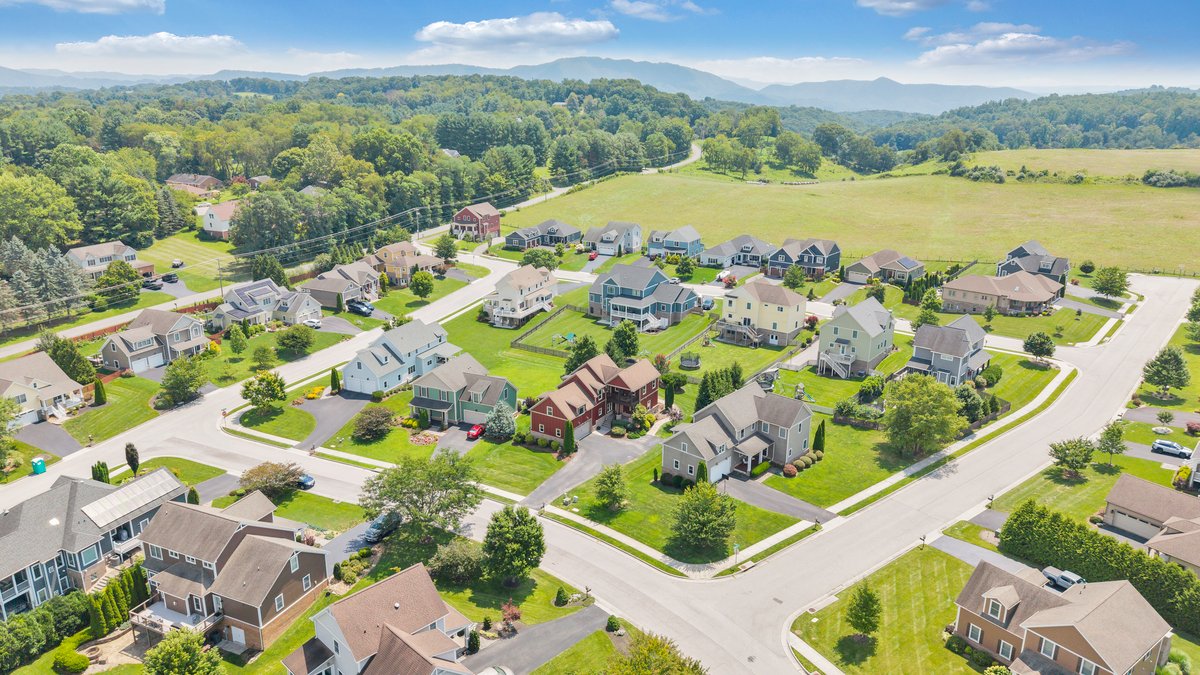
Then you have North Main, Tom's Creek, Hethwood, and Stroubles Mill. These are established, mature neighborhoods that a lot of buyers start to appreciate once they spend time here. You get tree canopy from the mature trees, proximity to campus, and a neighborhood feel that's made this region popular with faculty, staff, and long-term residents. Hethwood and Stroubles Mill are communities with their own amenities, and homes here can move quickly when they're priced well. Across this part of town, you'll see a lot of split-level and raised-ranch homes. Many are well located, and some have been updated, but you still want to pay attention to the lot, the slope, and how the home lives day to day.
And this is just Blacksburg. Each area of the New River Valley also has a completely different feel, and I cover that in other videos as well as in my Welcome to Blacksburg and the New River Valley magazine, which talks about how Blacksburg is different from Christiansburg and Radford, along with things to do and a snapshot of the housing market.
The information in this post is the kind that can help you feel confident about your purchase for years to come, instead of second-guessing things at closing. If you're planning a move to Blacksburg and you want someone who knows this market, please feel free to reach out. I work with relocating buyers coming into this area every day, and I can help you get a clear, specific picture of what your budget looks like right now, along with areas that might fit you well.
Frequently Asked Questions
Have Questions? Let's Talk.
I'm Grant Irby, a Realtor based in Blacksburg serving the New River Valley. Whether you're buying, selling, relocating, or investing, I'd be happy to help you think through your situation.
Schedule a Free Consultation