The Biggest Lies About Buying New Construction in Blacksburg, Virginia
A lot of what buyers believe about new construction in Blacksburg is out of date or was never quite right. Here's a clearer look at price, timelines, design decisions, representation, taxes, and incentives, including a conversation at The Preserve.
Grant Irby
REALTOR®, University & Main Real Estate Group · Keller Williams New River Valley
Almost every buyer I talk to repeats the same assumptions about new construction in Blacksburg. Some of those used to be true and no longer apply. Some were never really true in the first place.
In this post I'll walk through the ones I hear most often and what's actually happening right now, including a conversation I filmed at The Preserve with Molly Parrish, a sales consultant with Eagle Construction. My name is Grant Irby. I'm a Realtor here in Blacksburg, and if you're trying to figure out where to start with new construction, I'd be glad to help you narrow it down.
Lie 1: New construction is always more expensive
When buyers compare new construction to resale, the first thing they usually look at is the price. Sometimes a new home does cost more. But the comparison is rarely apples to apples, and in Blacksburg there is more than one new construction category.
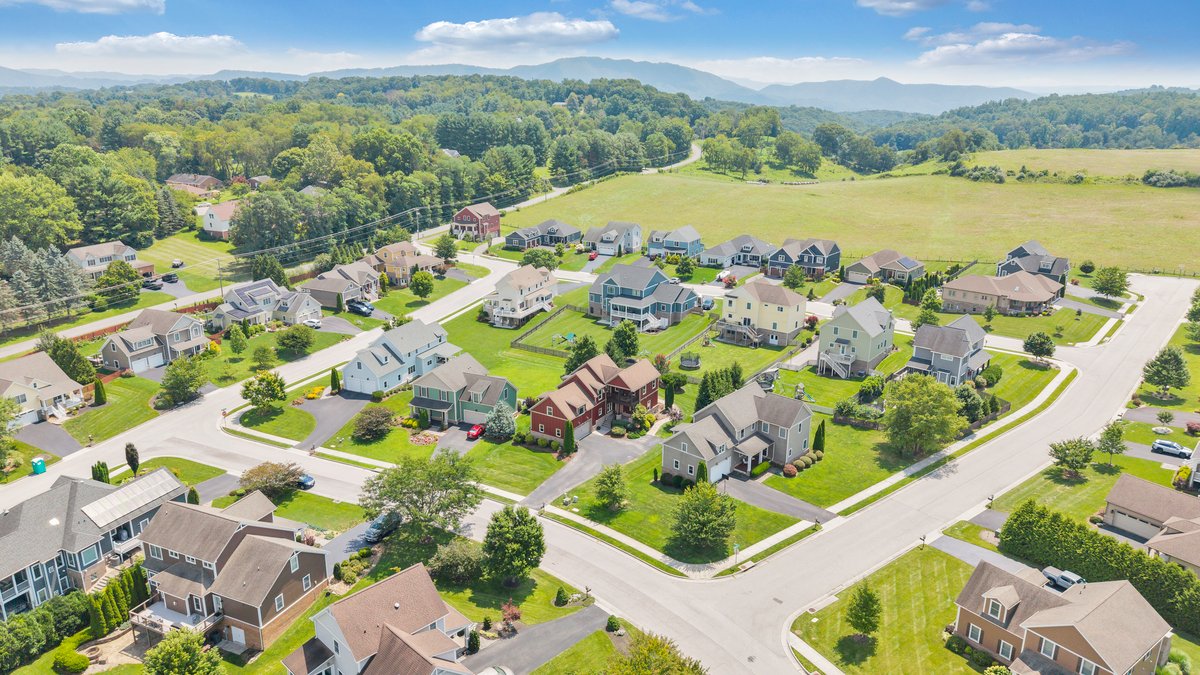
At The Preserve, just off Prices Fork Road, Eagle is not building one product at one price. Molly walked through three: townhouses starting around the $300,000s, villas (the attached product) starting around the $400,000s, and single-family homes starting in the $500,000s.
Zoom out nationally, and the gap has shifted in a way that surprises a lot of buyers. In March 2026, the National Association of Home Builders and the National Association of Realtors reported that a typical existing home was selling for slightly more than a brand-new home in 2025. In some product categories, that comparison has flipped entirely.
Molly's most common conversation with buyers who have already looked at resale is still about sticker price. The sales price can look like a shock until you start adding up what it costs to remodel a bathroom, change finishes, or get a resale home where you actually want it. Resale can also come with earlier repairs, like an HVAC system, water heater, or roof that's further along in its lifespan. I also see more bidding wars on resale than on new construction. Once you factor those things in, the two can start to even out.
There's also the warranty. Eagle's is a 1-2-10 warranty: the first year is essentially bumper to bumper for materials and workmanship, the second year covers systems behind the walls, and up to 10 years covers the structure. At Eagle, there's also a local person who oversees warranty work, so you're not calling a distant call center. On top of that, you're getting new appliances, a new HVAC system, a new water heater, and a new roof, many of which carry manufacturer warranties as well.
New construction is not always the least expensive option. It is also not always the most expensive one.
Lie 2: You have to wait six to 12 months
If you pick a homesite, pick a floor plan, and go through the design process from scratch, it can take six to 12 months. For some buyers, especially those with a home to sell or a new job start date, that timeline is a deal breaker. The myth is that it's the only way.
It isn't. Molly said Eagle tries to keep homes in various stages of construction. At the time we filmed, they had two homes that were completely move-in ready, two in framing, and a few permitted and held with the county. On a quick move-in home, closing can be as soon as about 30 days if the loan type allows it. A to-be-built home is still generally in that six-to-12-month range.
That's useful in this market because a lot of local builders don't build homes ahead of having a buyer. Eagle has been willing to keep some inventory for people coming in on a shorter timeline, including buyers starting jobs at Virginia Tech, a healthcare provider, or a local tech company.
The two move-in ready homes at the time were different on purpose: one single-story and one two-story. The Corvalis is a single-story, three-bedroom plan with an oversized shower and a bench seat, and it lives well for someone right-sizing. The one we looked at also had 8-foot doors, which makes a single-story home feel more spacious, and a screened, covered back deck that opens toward a more natural setting. The Savannah, which is also the model, is a popular plan with the bedrooms upstairs and, in the home that was for sale, three full bathrooms upstairs. It has a strong open connection between the kitchen and dining area.
If you want a specific lot or floor plan that isn't in the quick-move-in inventory, the process looks different. Eagle is semi-custom. Buyers start with one of five floor plans, then talk through how they actually live: a larger backyard for a dog, where they have coffee in the morning, whether someone needs a home office. Walls can be moved and plans permitted before the build starts, then designers and project managers get involved so everyone is working from the same plan.
Lie 3: You can change things later
This is the assumption that tends to cost buyers the most, not at the contract table, but two or three years later, when they're living with a decision they didn't realize was going to be permanent.
Cosmetic items like paint, light fixtures, and some hardware can often be changed later. Most buyers focus on what they can see and undervalue what they can't. The decisions that are nearly impossible to undo are the ones made during lifestyle selections and at the design center: the lot itself, how the house is rotated and how morning light comes into the kitchen, ceiling height, structural walls, the slope of the backyard, or the location of the driveway. Once the foundation is poured, the floor plan is set.
That's why, when we walk a model or review a floor plan, I like to spend less time on paint colors and more time on whether the lot works and whether the layout matches how you live. Those are the questions that stay with you well after closing, and they carry a lot of weight for long-term resale value too.
Lie 4: You don't need a Realtor to buy new construction
On a purchase of this size, I think it's important to have your own independent advocate. You want someone in the room whose job is to think about your money, your timeline, your resale value, your exposure in the contract, and your best interests.
I asked Molly a direct question: if a buyer walks in with their own Realtor, what does that cost the buyer at The Preserve? Her answer was that it does not cost the buyer anything. At The Preserve, they were offering buyer-agent compensation. A Realtor who has experience with new construction also knows the kinds of questions to ask and has context from working with that builder before.
Incentives are another conversation worth having. Molly said Eagle approaches them case by case, which buyers don't always love as an answer, but it depends on what's being offered at the time and what you can actually use. That might be help with closing costs, a refrigerator and washer and dryer in a speculative home, a rate buydown to lower the monthly payment, or more design credit for things like lighting or a backsplash. It's worth asking. The price on the sign along Prices Fork Road may not tell the whole story.
Lie 5: New construction homes have a higher tax rate and higher HOA fees
Buyers who skip this math often don't run into it until they're at the closing table, when adjusting the budget is much harder.
Property taxes in this area are not based on whether the home is new or resale. As of the recording of the video, the combined real estate tax rate inside the town of Blacksburg was $1.02 per $100 of assessed value: 26 cents for the town and 76 cents for Montgomery County. The Preserve is just outside Blacksburg town limits, but still in the Blacksburg public school system, so buyers there are charged only the county rate of 76 cents per $100 of assessed value.
A new home may have a higher tax bill if it is larger or valued higher, but that's tied to the home itself, not a penalty for being new construction. What buyers do need to watch is the timing of assessments. Montgomery County conducts general reassessments, and updated values from the 2027 reassessment were expected in the fall of 2026, effective January 1, 2027. If you close on a new home before that process is complete, the tax estimate at closing may be based on a land-only or pre-construction value. Once the finished home is assessed at full market value, that number can move. That's a conversation to have with your agent and your lender when you're looking at the payment.
Then there's the HOA. At The Preserve, the community has two amenity parks, a pickleball court, two children's playgrounds, a dog park, and a walking trail that connects them. The HOA also handles road maintenance, and for the townhouses and villas, lawn care as well.
When you add together the mortgage, taxes, insurance, and HOA, and compare that to a resale home the same way, the total monthly number is really what you're buying. The price on the listing is just where the conversation starts.
Lie 6: The number you see is always the final price
Some builders negotiate. Some don't. They don't all behave the same way. There are builders in town who will say, quite plainly, that they don't negotiate. I asked Molly if she had ever negotiated. Her answer was yes.
That is not a given, and it is not a guarantee. It is a conversation. Before you assume the printed price is the end of the discussion, pair that with professional representation. The worst they can say is no, and in this market, that may not be the answer.
A lot of buyers rule out new construction based on assumptions that haven't held up for a while. That gap between perception and reality is often where better buying decisions get made. If you're considering new construction at The Preserve and want to know what's available, I'd be glad to put together a current comparison based on your situation. That's the conversation to have before you make a decision.
Frequently Asked Questions
Have Questions? Let's Talk.
I'm Grant Irby, a Realtor based in Blacksburg serving the New River Valley. Whether you're buying, selling, relocating, or investing, I'd be happy to help you think through your situation.
Schedule a Free Consultation