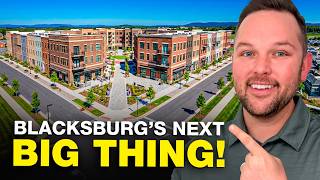
Why Christiansburg Is No Longer Blacksburg's Cheap Backup Plan: The New River Valley Housing Shift
For years, if Blacksburg prices got too steep, you simply pointed your search to Christiansburg. That playbook is officially outdated.
Grant Irby
REALTOR®, University & Main Real Estate Group · Keller Williams New River Valley
For years, there was an unwritten rule in this market. If Blacksburg prices got too steep, you
simply pointed your search a few miles down the road to Christiansburg. Same schools system
access, same commute to Virginia Tech, same amenities, lower price tag. It worked like
clockwork.
That rule is breaking down right now, and I think most buyers house hunting in this area haven't
caught up to what's actually happening.
I have this conversation on repeat with buyers who tell me, "We looked in Blacksburg, so we
figured we'd just check out Christiansburg instead." I get why they say it. That assumption used
to be true. It just isn't as reliable anymore, and if you're planning a move to the New River
Valley, understanding why matters more than you might think.
How the Blacksburg-Christiansburg Price Gap Actually Worked
Blacksburg has always carried a premium. Virginia Tech sits at the center of the local economy
as the region's largest employer, the downtown is walkable, and there's an energy here that
comes from being a true university town. Those factors pushed home values up year after year,
and when buyers felt priced out, Christiansburg was the natural release valve. Same access to
jobs and amenities, meaningfully lower cost of entry.
That dynamic held for a long time. It's shifting now.
Over the past five years, Christiansburg home values have climbed at a faster rate than
Blacksburg's in many stretches. Blacksburg currently sits around the mid-$500s for a typical
single-family home. Christiansburg has moved into the mid-$300s at the median, with plenty of
homes now landing in the low $400s. The spread between the two towns hasn't disappeared.
It's just operating on a much bigger scale than it used to, because both numbers have climbed
substantially.
A major driver behind this shift is new construction. Christiansburg has attracted a wave of
development activity: fresh communities, updated floor plans, and move-in-ready inventory that
has pushed entry-level pricing higher across the board. Add in projects like the Clifton Town
Center, a mixed-use development bringing retail and townhomes into the mix, along with the
town's current consideration of rezoning nearly 38 acres on Kimball Lane for additional housing,
and you can see Christiansburg is no longer riding Blacksburg's coattails. It's building its own
identity as a primary market in its own right.
Where Buyers Are Actually Heading Now
As Christiansburg's affordability advantage narrows, buyers looking for a lower entry point are
expanding their search radius even further.
Radford, about 15 minutes southwest, is typically running in the mid-$200s. Pulaski County,
anchored by the largest Volvo Trucks assembly plant in North America, sits closer to the low
$200s regionally, with the town of Pulaski itself landing in the mid-to-high $100s. New
development is actively planned across that county too. Giles County, just north of Blacksburg,
is posting some of the fastest percentage growth in the entire region as buyers trade a slightly
longer commute for more land, more open space, and direct access to the New River.
Blacksburg is no longer just competing with the town next door. It's sitting at the center of a
pricing shift playing out across the whole New River Valley, and that changes how both buyers
and sellers need to think about this market.
What's Really Happening With Inventory
When buyers hear that the market has slowed down, the assumption is usually that inventory
has bounced back. There are more listings on the board than during the extreme shortage years
of COVID, sure, but the full picture is more nuanced than that headline suggests.
Blacksburg has operated with tight inventory for a long time, and the construction capacity
across this region never fully recovered after the Great Recession in 2008. Plumbers,
electricians, framers, and specialty contractors took real hits during that downturn, and a lot of
local projects today still depend on crews traveling in from outside the New River Valley. That
adds cost and adds time to every build. The underlying shortage from that era hasn't been
resolved.
Active listings across Blacksburg, Christiansburg, and Radford are up year-over-year, but that
increase is coming off an extremely low starting point. We're still well below what would qualify
as a balanced market here.
So where is new construction actually happening? Inside Blacksburg proper, most of the current
activity centers on student housing. The Rambler, an eight-story, 247-unit development near
Virginia Tech, is the largest project underway, expected to open for the 2028-2029 school year.
It's a significant addition to student housing inventory, but it will take time before that supply
meaningfully affects buyers looking for single-family homes.
When it comes to single-family construction, most of that action is happening outside
Blacksburg town limits. Christiansburg has multiple new construction communities actively
selling right now, and out in Montgomery County near Prices Fork, still carrying a Blacksburg
address but outside town limits, developers are building hundreds of units. If you're hunting for
new single-family construction in the New River Valley, your search will likely lead you outside
the actual town limits of Blacksburg, even while staying close to campus.
Homes priced appropriately and presented well are still moving at a healthy pace. Homes that
come to market with an overly ambitious price are sitting, and that selectivity is shaping the
experience for buyers and sellers alike right now.
Why Buyers Should Rethink the "Aggressive Negotiation" Approach
With more listings on the market and rates still elevated compared to 2021 and 2022, it would
be reasonable to assume there's room for buyers to negotiate hard. In Blacksburg specifically,
that approach tends to backfire, and here's why.
Blacksburg is insulated from national economic cycles in a way most smaller markets, and even
a lot of larger ones, simply are not. Virginia Tech is the region's largest employer, and the
demand tied to the university isn't cyclical. It's structural, and it continues to grow. First-year
applications for fall 2025 approached almost 58,000, a university record and a 6.1% increase
year-over-year.
The broader New River Valley economy backs this up. In 2023, GDP growth here ranked
second among Virginia metro areas and came in ahead of the national average, supported by
advanced manufacturing, information technology, higher education, and biomedical research.
This is not a sleepy, stagnant rural economy.
Geography plays a role too. Blacksburg is largely boxed in between the university campus,
national forest land, and agricultural reserves. There's a hard ceiling on buildable land within
town limits, and that constraint isn't going anywhere. It's a big reason values here have held up
so consistently over time.
Put enrollment growth, limited land, and a strong regional economy together, and a sharp price
drop just isn't in the cards. The Federal Housing Finance Agency's House Price Index for the
Blacksburg-Christiansburg Metro has climbed steadily since 2020, following over a decade of
relatively flat pricing before that. The pace of appreciation has cooled somewhat, but the
underlying support for values is still firmly in place.
Instead of asking whether you can talk a seller down on a specific property, ask a better
question: what is this property likely to be worth in 5 to 10 years? In an insulated market with
limited supply, consistent demand, and a growing institutional anchor like Virginia Tech,
well-located Blacksburg properties tend to hold value and appreciate meaningfully over time.
Staying in this market has historically outperformed trying to time it, and the data backs that up.
What Sellers Need to Understand About Today's Competition
That same market strength creates a very different set of dynamics for sellers, and this is where
expectations need to come back down to earth.
Back in 2021, sellers had it easy. You could under-prepare a home, price it above comparable
sales, and still field multiple offers. Inventory was at historic lows, rates were artificially low, and
buyers moved with urgency. That created a seller's market unlike anything this area had seen in
a long time. That environment is gone, and sellers still operating like it's 2021 are feeling the
consequences: longer days on market, price reductions, and final sale prices lower than what
the right strategy could have delivered from the start.
Here's the competitive reality a lot of sellers aren't factoring in. You're not just competing with
the home two doors down anymore. You're competing with new construction inside and outside
Blacksburg town limits, and in Christiansburg. You're up against modern floor plans, builder
warranties, energy-efficient systems, and homes that are fully move-in ready. You're also
competing with larger lots and newer builds in Radford and Pulaski County, where buyers can
often get more space at a lower monthly payment. In a mid-6% interest rate environment, that
monthly payment is exactly what buyers are focused on.
The age gap matters here too. A large share of Christiansburg's single-family homes were built
in the 2000s, while a lot of Blacksburg's housing stock dates back to the 1970s and 1980s.
When a buyer is weighing an older home that needs updates against a newer build at a similar
or even lower price, the Blacksburg seller has to work harder to make that decision make sense.
Pricing has to reflect where the market is today, not two or three years ago. In Montgomery
County, the average sales-to-list price ratio sits around 99%, down from over 100% in 2022 and
- That means homes are typically closing about 1% below list price. Homes priced too high
face real consequences: longer time on market and, often, a lower final sale price than if they'd
been priced correctly from day one.
Sellers who understand they're competing in a regional market, not just within Blacksburg's town
limits, and who price and prepare accordingly, are still seeing strong results. Sellers relying on
the area's historical price premium without backing it up with condition and strategy are often
leaving money on the table.
The Bigger Picture: A Market That's Maturing, Not Declining
Step back and look at all of this together, and a clear pattern emerges. Christiansburg's
affordability edge is narrowing. Inventory inside Blacksburg town limits remains structurally tight.
Buyers need to think in terms of long-term value rather than today's price point alone. Sellers
are now competing across the entire region rather than just within their own neighborhood.
None of this is a short-term blip that's going to snap back. This is a market maturing in real time.
Christiansburg is no longer the discount fallback option. Projects like the Clifton Town Center
and the $18 million, 50-acre Huckleberry Park Sports and Recreation Complex are turning the
town into a destination in its own right, and pricing tends to follow that kind of growth.
Regional competition keeps expanding too. Pulaski County, Giles County, and Radford aren't
backup options anymore. They're legitimate primary choices offering strong value. The Volvo
plant in Dublin continues fueling Pulaski's economy and housing demand, and Giles County
keeps drawing buyers who want more space and river access.
Meanwhile, Blacksburg itself remains structurally limited on inventory. Between the university,
the national forest, and the agricultural reserves, there's only so much room left to build.
Combine that with construction capacity across the New River Valley still being constrained, and
the pipeline for new single-family homes inside town limits stays tight. Scarcity like that tends to
hold value over time.
Virginia Tech's research presence keeps expanding, so demand tied to the university isn't
slowing down anytime soon. And the broader New River Valley economy continues performing
well, recognized as one of the fastest-growing economies in the state, backed by a diverse mix
of advanced manufacturing, information technology, higher education, and biomedical research.
Blacksburg isn't declining. It's maturing. And in a market like this, outcomes get decided by
strategy, not emotion.
Your Next Move in the New River Valley
Blacksburg rewards buyers and sellers who understand the moment they're actually standing in,
not the market that existed three or five years ago. If you're weighing a purchase or thinking
about listing your home anywhere in the New River Valley right now, get a clear, objective read
on where you stand before you make a move. Reach out to me directly at granterby@kw.com
and let's talk through your specific goals. Whether you're figuring out what your budget really
gets you as a buyer or how to position your home to compete in this new landscape as a seller,
I'm here to help you make a confident, informed decision in this market.
Frequently Asked Questions
Have Questions? Let's Talk.
I'm Grant Irby, a Realtor based in Blacksburg serving the New River Valley. Whether you're buying, selling, relocating, or investing, I'd be happy to help you think through your situation.
Schedule a Free Consultation